Strategic amnesia: Climate risks Canada keeps relearning
In a recent article for the Globe and Mail, Strategic Amnesia: Futures at Risk, the author argues that many modern-day catastrophes, such as wildfires and infrastructure collapses, are not a result of unknown risks, but of institutions that have lost the ability to remember to act on what is known. This article illustrates how catastrophes are not about the failures of technology and the lack of expertise. Instead, they are about the failure of institutional memory, otherwise known as “strategic amnesia.”
The concept of strategic amnesia is introduced by the author, described as the deliberate structural condition in modern institutions when organizations preserve records and warnings, but strip them of action or force. Knowledge exists, this much we know, but it is fragmented across silos where there is no single authority responsible for it, which is fueled further by economic and political incentives that reward moving forward instead of slowing down to address the root or risks. As a result the author suggests, rather than operationalizing the knowledge we have, it becomes an archived memory and pointed out only after disaster occurs.
The author illustrates how this pattern repeats itself by using a series of historic and contemporary examples, to emphasize how this is not a failure of documentation but instead, a conflict between “story” and “body.” When governments and institutions choose to prioritize efficiency and profit over truth and research, they lead with narratives that claim safety over the physical reality of climate disasters and aging infrastructure.
Climate risks are not speculative. Scientists, Indigenous leaders, and researchers continue to document the escalating risks of wildfires, floods, and extreme heat for instance. Yet action is frequently delayed by our leaders. This article makes it clear that climate governance does not suffer from a lack of evidence or information, but instead from a lack of accountability for remembering that information and using it for action and resilience. When the responsibility to synthesize climate patterns and information gets muddled, disasters repeatedly get framed as exceptional, despite actually being predictable.
Strategic amnesia is a choice. In Canada, addressing climate change, and being climate ready and resilient, requires a governance system where past events and evidence actually carries weight. Post-crisis explanations of catastrophes are not enough. We must use what we know to propel action.
Written by Sabrina Careri
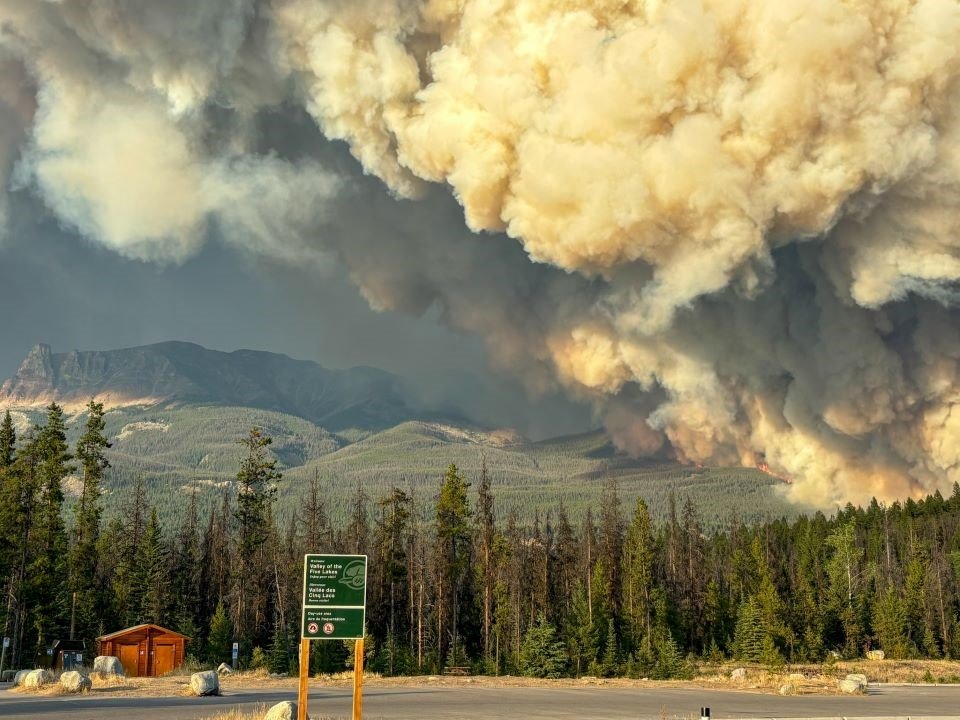
Wildfire smoke above the Valley of the Five Lakes in Jasper National Park in 2024. Source: Parks Canada from TownandCountryToday.com